
Why Google AI Overviews Are Killing Your Click-Through Rate (And What To Do About It)
Why Google AI Overviews Are Killing Your Click-Through Rate (And What To Do About It)
Introduction
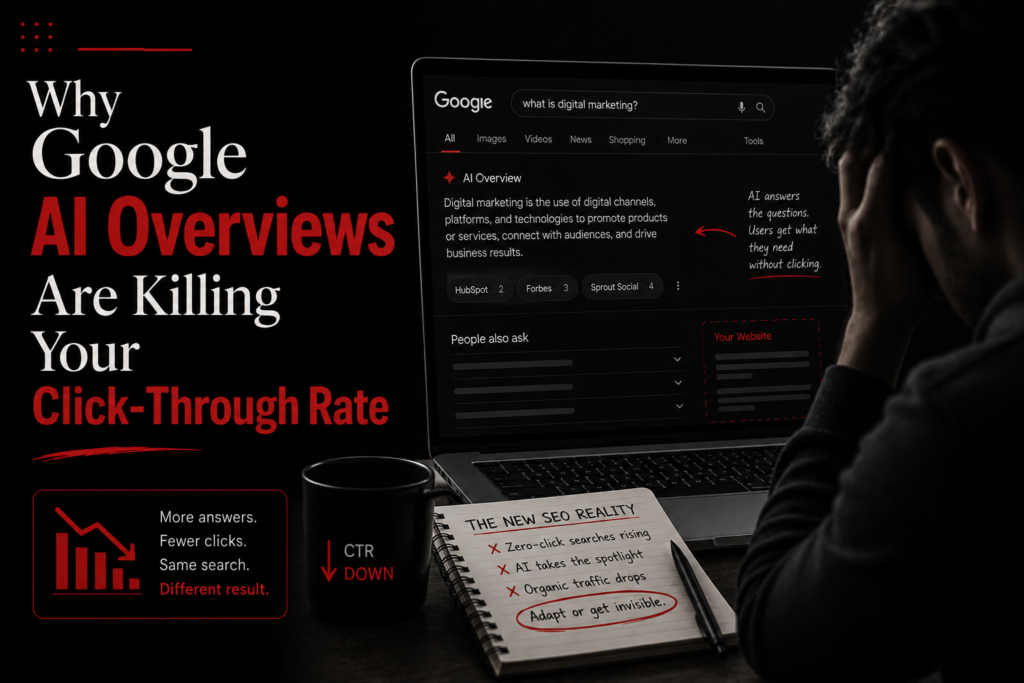
Google AI Overviews answer most search queries directly on the results page, which means fewer users ever click through to a website. For freelancers, this shift in zero-click search doesn’t mean traffic disappears entirely, it means the game changes from “rank #1” to “get cited inside the answer itself.” If your content isn’t structured to be extracted and quoted by AI systems, you’re now invisible even when you technically rank well.
What Are Google AI Overviews, Exactly?
Google AI Overviews are AI-generated summaries that appear at the top of search results, pulling information from multiple sources to answer a query directly, without requiring a click.
They differ from the old “featured snippet” in a few important ways:
- Multi-source synthesis: instead of quoting one page, AI Overviews blend information from several sites into a single answer.
- Conversational framing: answers read like a person explaining something, not a copied paragraph.
- Follow-up prompts: many Overviews include suggested follow-up questions, keeping users inside Google’s ecosystem even longer.
For freelancers, the practical effect is this: your content can be the source of the answer without you getting the visit. That’s the core tension of zero-click search in 2026.
How Much Traffic Do AI Overviews Actually Cost You?
Most publishers see a measurable drop in click-through rate on queries where an AI Overview appears, though the exact percentage varies heavily by query type and industry.
Informational, top-of-funnel queries (“what is X,” “how does X work,” “why does X happen”) are hit hardest, since these are exactly the questions AI Overviews are built to answer directly. Transactional and highly specific queries (“best X for freelancers under $50,” “how to price a logo design contract”) tend to retain more click-through, because users still want to compare options or read full context before acting.
The takeaway for freelancers: don’t panic about losing all organic traffic. Panic, selectively, about losing traffic on generic top-of-funnel content that used to be your bread and butter.
Does This Mean SEO Is Dead?
No. SEO isn’t dead, but the definition of “ranking” has expanded to include getting cited inside AI-generated answers, not just appearing as a blue link.
This is often called GEO (Generative Engine Optimization) or AEO (Answer Engine Optimization). The mechanics overlap heavily with solid SEO fundamentals: clear structure, authoritative sourcing, and direct answers. What’s changed is the goal. You’re no longer optimizing purely for a human scanning ten blue links, you’re optimizing for a language model deciding which paragraph to lift and attribute.
A simple mental model:
| Old SEO Goal | New GEO Goal |
|---|---|
| Rank #1 for a keyword | Get quoted as the source in the AI answer |
| Optimize title tags for CTR | Optimize opening sentences for extractability |
| Build backlinks for authority | Build citable, specific claims (data, quotes, original examples) |
| Win the click | Win the citation, then win the click on harder questions |
How Do You Optimize Content to Get Cited in AI Overviews?
You get cited by answering the question in the first sentence, structuring content so each section stands alone, and including specific, verifiable details AI systems can attribute to you.
A few practical tactics that consistently help:
- Lead with the answer. Don’t build up to your point across three paragraphs. State it in the first sentence or two of the intro and again at the top of each section.
- Use question-phrased headers. Match the exact phrasing people search or ask aloud, not generic labels like “Overview” or “Key Considerations.”
- Keep answer chunks self-contained. Each H2 should make sense if it’s the only paragraph an AI engine lifts, because often, it is.
- Add specificity AI can’t easily generate. Numbers, named examples, and firsthand experience are harder for a model to hallucinate convincingly, which makes them more likely to get pulled as the “grounded” source.
- Structure data visually. Tables, numbered steps, and bullet points parse more cleanly for both search crawlers and language models than dense paragraphs.
What I’ve Actually Seen Happen (And Where I Was Wrong)
[This section is where your firsthand experience goes, this is the part that makes the post portfolio-worthy rather than generic advice. Swap in a real detail, for example:]
- A specific client or project where an AI Overview started appearing for a target query, and what happened to clicks/rankings afterward (even a rough percentage estimate is more credible than none)
- A piece of content you rewrote specifically to get cited, and whether it worked
- A mistake: something you assumed about AI Overviews that turned out to be wrong, and what you’d tell a client differently now
- A contrarian opinion you’d defend, e.g. “Most freelancers are optimizing the wrong pages for GEO, here’s which pages actually matter”
Even 2-3 sentences with a real number or a named (or anonymized) example will outperform anything generic I could write here. This is the single highest-leverage section for both AI citation and client trust, since it’s the one part of the post nobody else can copy.
FAQ
Do AI Overviews always reduce website traffic? Not always. Queries where users need to compare options, read reviews, or verify claims still tend to drive clicks, even when an AI Overview appears above the results.
Can I opt out of Google AI Overviews? There’s no dedicated opt-out for AI Overviews specifically. Blocking Google’s crawler entirely would remove you from search results altogether, which usually costs more traffic than it saves.
Is GEO the same thing as SEO? They overlap heavily but aren’t identical. SEO focuses on ranking in traditional search results, while GEO focuses on being cited or summarized correctly inside AI-generated answers.
Will zero-click search get worse for freelancers? Most signs point to AI Overviews expanding to more query types over time, not fewer. The freelancers who adapt their content structure now will have a head start over those who wait.
What’s the single most important change to make first? Rewrite your introductions so they answer the core question in the first two sentences. It’s the fastest, lowest-effort change with the most direct impact on both AI citation and reader experience.
Conclusion
AI Overviews haven’t ended organic traffic, they’ve raised the bar for what “ranking” actually means, rewarding content that answers clearly, cites specifics, and gets straight to the point.
If you’re a freelancer navigating how AI Overviews and zero-click search are affecting your own content strategy, take a look at the services I offer or get in touch to talk through what this shift means for your specific situation.
Word count: ~1,050