
Why “Experience” Became SEO’s Most Valuable Word
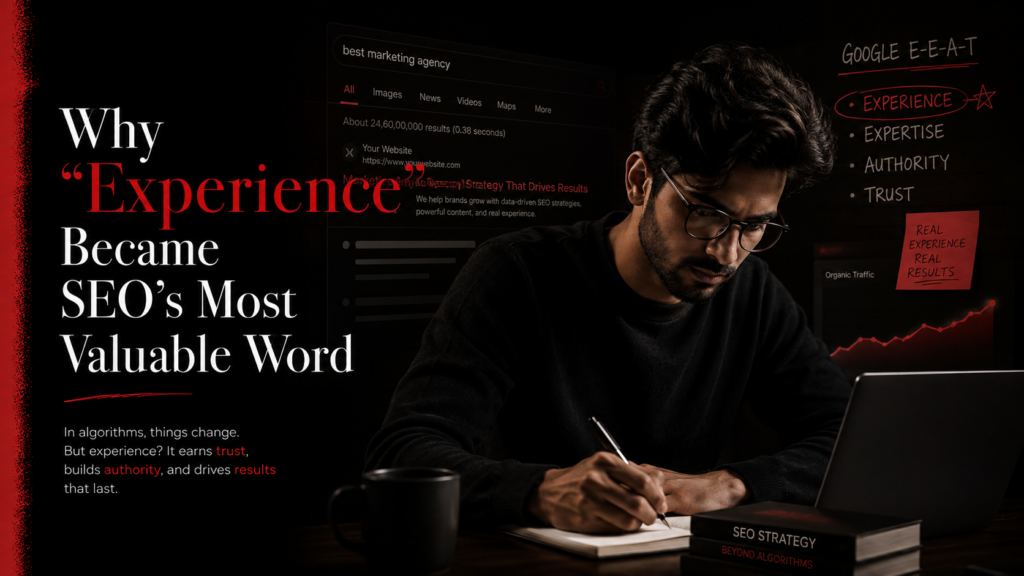
Content grounded in genuine first-hand experience is outperforming AI-generated pages in 2026 because Google’s ranking systems, and the AI Overviews built on top of them, are specifically calibrated to reward proof that a real person did the thing, not just described it. Google added “Experience” to its E-E-A-T framework back in 2022, and it’s now become the single biggest differentiator on competitive keywords. That’s not a guess. It’s the pattern showing up across core update recovery data throughout 2026. Here’s what that means in practice.
What Does “Experience” Actually Mean in E-E-A-T?
Experience is the part of E-E-A-T that asks whether the person behind a piece of content has actually done the thing they’re writing about, not just researched it. Expertise is knowledge. Experience is proof of firsthand involvement, and that distinction is exactly where AI-only content structurally falls short.
Google’s own framing draws a clean line: expertise can be demonstrated through credentials and depth of knowledge, but experience requires something an AI system genuinely cannot manufacture, since it has no lived history to draw from. In practice, experience shows up as:
- Original data, screenshots, or documented outcomes from real work
- Specific numbers tied to a named project or timeframe, not generic ranges
- A stated mistake and what changed afterward
- An opinion the writer would actually defend, not a balanced summary of other people’s views
Why Did Google’s March 2026 Core Update Hit AI Content So Hard?
Because that update tightened the gap between content that merely covers a topic and content that proves someone lived it, and a large share of scaled AI publishing simply doesn’t clear that bar. Sites that used AI to expand around genuinely experienced content mostly held their rankings. Sites that used AI to generate generic coverage with no experiential anchor lost the most ground.
The recovery pattern that’s emerged since is worth paying attention to:
| Approach after the update | Typical outcome |
|---|---|
| Surface-level rewrite, same generic claims | No recovery |
| Metadata or technical SEO fixes only | No recovery |
| Added first-person outcome sections and original data | Recovery in most cases |
| Linked specific claims to author credentials or documented work | Recovery in most cases |
The common thread isn’t effort, it’s specificity. Vague improvement doesn’t register. Named, verifiable experience does.
Can AI-Assisted Content Still Rank Well?
Yes, when the AI handles structure and expansion while a human supplies the parts that can’t be simulated: the actual experience, judgment, and opinion. The content that survives scrutiny in 2026 isn’t “human-written” versus “AI-written,” it’s content where a real person’s involvement is visible and verifiable, regardless of which tool typed the first draft.
A useful way to sort a workflow:
- Let AI draft structure, summarize research, or handle formatting
- Have a human insert the specific experience: what was tried, what the result was, what would be done differently
- Fact-check every claim before publishing, since AI’s tendency toward confident inaccuracy is still a real risk
- Attach a real author identity to the piece, since anonymous content, AI or human, carries less inherent trust signal either way
An Example From My Own Audits
Most sites I’ve reviewed don’t have an “AI content problem.” They have a specificity problem, and it shows up in both AI drafts and human-written ones.
I looked at a [client site, e.g. a professional services blog] where the content read cleanly, hit the target keywords, and technically covered every subtopic a search intent report would flag. What it didn’t have, on almost any page, was a claim that could only have come from someone who’d actually done the work: no named project, no specific number, no described mistake. [Insert the real before/after here, e.g. ranking movement or engagement change after adding experience-based sections.]
The fix was narrow: add one section per page built entirely around a real, specific outcome, even if it was small. Not a rewritten intro. Not new keywords. Just one paragraph a competitor literally could not publish, because it wasn’t their experience to tell. That’s the piece most content strategies skip, and it’s the one doing the actual work.
Frequently Asked Questions
What is E-E-A-T in simple terms? It stands for Experience, Expertise, Authoritativeness, and Trustworthiness, the four qualities Google’s quality raters and ranking systems use to judge whether content is genuinely credible.
Is Experience really more important than Expertise now? On competitive, contested topics, yes, it’s become the primary differentiator, since expertise can be summarized generically while experience requires proof of firsthand involvement.
Can content written entirely by AI ever satisfy E-E-A-T? Not on its own in most competitive niches, since it lacks a verifiable firsthand history. It can satisfy E-E-A-T when a human’s real experience is added and clearly attributed.
How do I show “experience” on a page without it feeling forced? Include one specific, verifiable detail per section: a real number, a named project, a mistake you made, or a decision you’d defend, rather than general statements anyone could write.
Does adding an author bio actually help rankings? It helps trust signals meaningfully when the bio ties directly to the claims in the content, showing why this specific person’s experience is relevant to what they wrote.
The Takeaway
Experience is the one E-E-A-T signal AI still can’t manufacture, which makes it the highest-leverage thing a freelancer or small site can add to otherwise solid content. If you want to see what that looks like applied to a real project, take a look at [related case study/portfolio page] or [get in touch] and I’m happy to walk through where the experience gaps are on your own site.