
The New SEO Job: Getting Quoted, Not Just Ranked
Meta description: Google AI Overviews now shape nearly half of all searches. Here’s the specific shift in strategy that’s actually working for SEO freelancers in 2026.
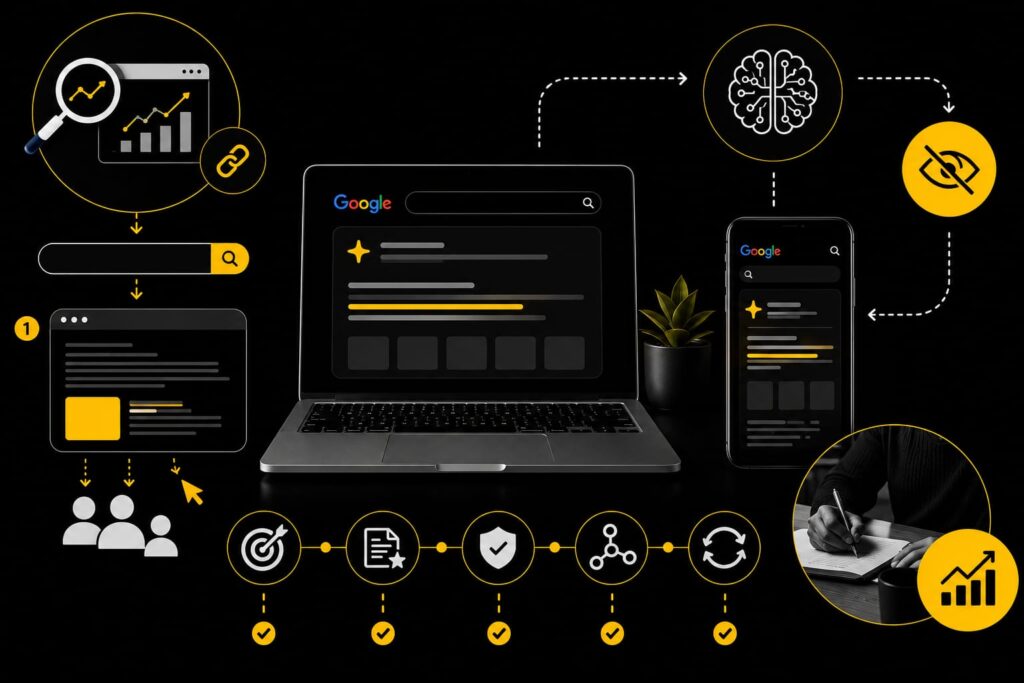
The core shift caused by Google AI Overviews isn’t traffic loss, it’s a change in what counts as a win. When an AI Overview appears, organic click-through rate typically falls by 50 to 61%, but sites that get quoted inside that summary still pull in roughly double the clicks of sites that rank on page one and get ignored. So the real question for 2026 isn’t “how do I rank,” it’s “how do I become the answer the AI system trusts enough to repeat.” That’s a content and structure problem, not a keyword problem, and it’s solvable.
Why Are My Rankings Fine But My Traffic Is Down?
Because ranking and getting clicked are no longer the same outcome. A page can hold position one and still lose most of its clicks if Google’s AI Overview answers the query directly above it.
This is showing up unevenly across the web right now:
| Query type | AI Overview presence |
|---|---|
| Healthcare | ~88% |
| Education | ~83% |
| B2B tech | ~82% |
| Restaurants | ~78% |
| E-commerce | ~4% |
If your traffic dropped and you’re in one of the high-coverage categories, the ranking report isn’t lying to you. The click math changed underneath it. If you’re in e-commerce or another low-coverage category, something else is probably going on and it’s worth checking before blaming AI Overviews by default.
What Actually Gets a Page Cited Inside an AI Overview?
Pages get cited when they answer one specific question cleanly, near the top of the section, with language a model can lift without editing. Ranking well still matters, but it’s no longer sufficient on its own: recent data shows only about 17% of AI Overview citations now come from pages sitting in the organic top 10, down sharply from a couple years ago.
What tends to correlate with getting cited:
- The answer sits in the first sentence or two of the section, not buried after context-setting
- Headers are phrased as actual questions, matching how people search or ask aloud
- Claims are attributed to a named source, which gives the model something concrete to restate
- Data is presented in short tables or lists, since that structure parses more cleanly than narrative paragraphs
- The same terms are used consistently for core concepts, instead of swapping in synonyms for “readability”
None of that is exotic. It’s mostly discipline that a lot of content teams dropped once they were writing purely for keyword coverage.
Does This Mean Traditional SEO Doesn’t Matter Anymore?
No, it means traditional SEO is now necessary but not sufficient. You still need to rank to be considered for most citations, and plenty of query types, especially transactional and local ones, rarely trigger an AI Overview at all.
Practical shifts I’ve made in how I approach client sites:
- Stop chasing broad topic coverage and start building pages around single, answerable questions
- Weight new content investment toward query segments with lower AI Overview coverage, where a click is still a realistic outcome
- Keep the traditional fundamentals (technical health, backlinks, page speed) as the floor, not the strategy
- Review existing high-traffic pages first, since restructuring them is usually faster than producing new content from scratch
A Mistake I See Constantly, and What Fixed It
Most sites I’ve audited don’t have a content quality problem. They have a structure problem, and it’s an easy one to miss because the content still “reads fine.”
Here’s the pattern: [client site, e.g. a mid-size B2B SaaS blog] had strong technical SEO and decent backlinks, but almost every article opened with two or three paragraphs of scene-setting before answering the actual question in the H2. That’s a normal, even good, habit for human readers who are used to scrolling. It’s close to invisible to a system trying to extract a self-contained answer from the first few lines of a section.
The fix wasn’t new content. It was moving the direct answer to the first sentence of each section, cutting the throat-clearing intros, and adding one comparison table per page where it made sense. [Insert the actual result here, e.g. change in AI Overview citation appearances or referral traffic over X weeks.] Nothing about the underlying expertise changed. What changed was how easy that expertise was to lift. That’s the whole insight, and it’s the part most “AI SEO” advice skips because “restructure your existing content” doesn’t sound as impressive as a new tactic.
Frequently Asked Questions
Is SEO dead because of AI Overviews? No. It’s expanded. Ranking well is still required, it’s just no longer the finish line on its own.
Will optimizing content for AI Overviews hurt my regular search rankings? No, the two mostly reinforce each other. Clear answers, credible sourcing, and scannable structure help both traditional rankings and AI citation chances.
How fast can I expect to see results after restructuring content for AI Overviews? Usually a few weeks to a couple of months, since AI Overviews tend to re-crawl and re-summarize content faster than traditional search rankings shift.
Are some industries affected more than others? Yes, significantly. Healthcare, education, and B2B tech see AI Overviews on the large majority of queries, while e-commerce sees them on a small fraction, so the urgency depends heavily on your niche.
Is it worth it for a small site or solo freelancer to optimize for this? Yes, arguably more than for large sites. Citations are increasingly coming from outside the traditional top 10, which is an opening that didn’t really exist when citations tracked closely with ranking position.
The Takeaway
Google AI Overviews didn’t kill SEO, they just changed the finish line from “rank well” to “get quoted,” and that’s a structure and clarity problem you can actually fix. If you’re trying to figure out what that looks like for your own site or a client’s, take a look at [related case study/portfolio page] or [get in touch] and I’m happy to walk through what a real AI Overview audit would surface.